Here’s a fun new idea. I was toying with doing another “What I’ve been reading / playing / watching” post, because Christmas has been a whirl, and I hit on the idea to do a blog on my recommendations for 2024.
Now to be clear, these books / movies / games didn’t all come out in 2024, I just discovered them this year. It’s not maybe the cleanest way to do things, but my media consumption is all over the place, and hey, I’m just doing this for my own fun.
Best Books of 2024
The Anxious Generation by Jonathon Haidt

This one doesn’t need much promo-ing, you’ve probably heard of it in millions of places by now. It honestly disturbs me a little how popular the book is, I’m always a bit distrustful of anything that too many people seem to be endorsing. Popular movements just always seem to over-correct and go wrong.
But the thing is, I do agree with a lot of what Haidt says in his book, to the point that I delivered a lecture on it at a teaching convention. I do think there’s a problem with the way social media twists our brains, and I do think the way we coddle kids in the real world also is problematic. I think what he hints at with pornography and video games with boys is worth studying in a great more detail, and his admission about the damage the loss of “sacredness” has done to our culture is, for an atheist, remarkable.
I could wish certain portions of his book were supported by a bit more detail. A part of me is worried that people will take Haidt’s work and go too far in the opposite direction. But a larger part of me thinks it’s an important work that is generating the first trend in education I’ve felt hopeful about for some time!
The Awakened Brain by Lisa Miller
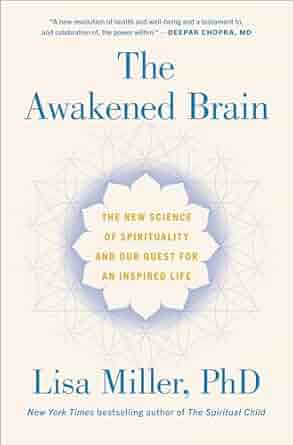
Speaking of Haidt’s reflection on the need for “sacred spaces”, he referenced one of my other more intriguing reads this year, The Awakened Brain by Lisa Miller. Though billed as an examination of how religion and spirituality impacts our mental health, it’s written more as a memoir of Lisa Miller’s life, bouncing from her work in with clinically depressed patients to her struggle with infertility to an intense session spent in a Indigenous Sweat Lodge.
It’s a mistake to think of Miller’s book as advocating any one particular religion, or even religion at all–her focus is more on spirituality, which she connects with singing, group events, and occasional bouts of meditation in nature. The only really specific religious practice she focuses on, other than the indigenous ritual, is a Jewish festival. But despite that, and the somewhat anecdotal nature of much of her book, nonetheless there shines through strong evidence that a religious / spiritual backing can powerfully brace a person to deal with depression and trauma.
Miller also makes it clear that she has written several more scholarly articles on the link between spirituality and depression, but that the medical establishment at large (with some few notable exceptions) have been oddly dismissive of her work, even trying to blow off concrete proof shown through MRI and CAT scans. Part of me wishes she’d included more of that scientific work here, but then, part of the point of her book is that life is more than the scientific.
The Blacktongue Thief by Christopher Buehlman

Generally, I enjoy fiction more than nonfiction. And I like to bill myself as a fantasy lover, but in truth I’ve probably read more sci-fi. So I was glad to find a new fantasy story this year that I found deeply fascinating.
The Blacktongue Thief is not a typical, nor a clean fantasy. It’s more in the vogue of an old-timey Welsh folk tale, with all the crudity, sexuality, and violence that implies. The goblins in the story actually do eat humans, which the protagonist even witnesses not once, but twice (though few details are given). And the goblins aren’t even the greatest evil in the story.
So why did I find it so fascinating? Put simply, the world, and the narrator’s voice. Christopher Buehlman puts together a richly detailed world that is both fantastical and familiar, full of its own idiosyncracies and customs and languages. It’s a world so detailed that half of the story is nearly solid exposition delivered via the story’s protagonist–which is the sort of thing that would be absolutely fatal if the protagonist didn’t have such a sense of charm and an impeccable sense of keeping things hidden and mysterious until the right moment. And all the exposition weaves wonderfully into the plot until the series of grand reveals at the end that lead you to think that maybe this terrible world will, in fact, be made better.
Which makes it rather frustrating to learn that Buehlman has opted, instead of a sequel, to write a prequel to the story. Prequels, which are almost inherently uninteresting. Oh well. I’m sure he’ll get to the sequel eventually.
Everything Sad is Untrue (A True Story) by Daniel Nayeri

I was unsure about whether to actually include this one. It’s a good and remarkably effecting book, I’m just not sure if it’s truly the best thing I read this year. In the end I decided to include it because I needed another entry and because, well, it is a good book that could use more press.
Essentially, it’s the story of Daniel (formerly Khouzo) Nayeri, an Iranian refugee in America circa 2003 (with all that implies). Told from the perspective of his 8-year-old self, the story bounces between mythical tales of Iran’s past, to legends about Daniel’s family, to dirty present-day realities of his abusive stepfather and bullying classmates. Themes and symbols are woven together in a manner that is often confusing but always entertaining (and as Daniel points out, such meandering is common in Middle-Eastern storytelling, it’s just Western storytelling that finds it odious).
My disappointment with this story is largely petty–for a large part of it, everything in the story is depressing and unrelentingly horrible. Which, life is like, sometimes, but I very nearly gave up the story at a point where I thought he was about to lose his only friend in the book.
I’m glad I didn’t, though. Because the story does come around and show the redemptive power of the suffering Daniel has endured, as well as the ability of stories to connect people and bring them together. It was, in many ways, a remarkably effecting story. It just… took a bit to get there.
Best Movies of 2024
The Guardians of the Galaxy Holiday Special
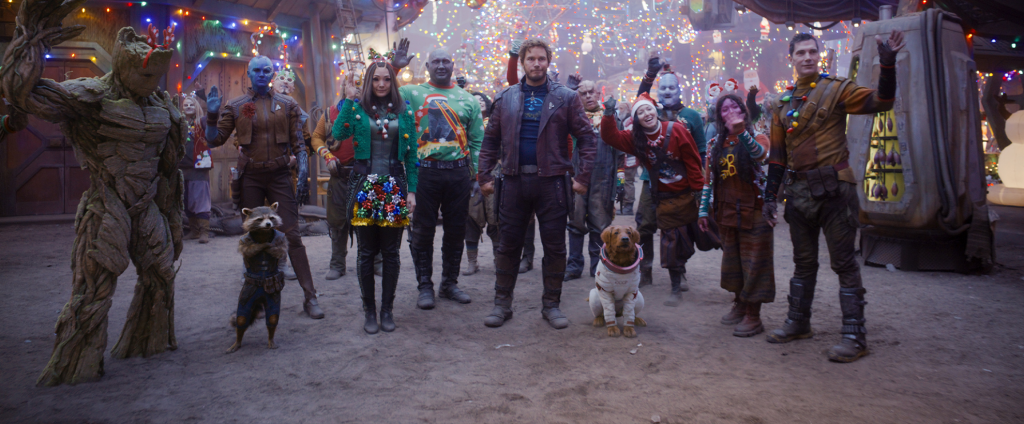
This, of course, came out several years ago, yet I only watched it this past month, out of a desperate need to find an original Christmas movie for my students to watch and respond to (although several refused to do that, even).
To my surprise, it turned out to be a special that, while cheesy, hit some very strong emotional notes as Peter Quill’s friends set out to give him the best Christmas that he’s always missed out on for all these years–even if they don’t remotely know what Christmas even is. There’s nothing here about the origins of Christmas, or its religious significance, but there is quite a lot about the strength of friendship and the importance of found family. It was quite a heartfelt little piece.
The Hidden Fortress
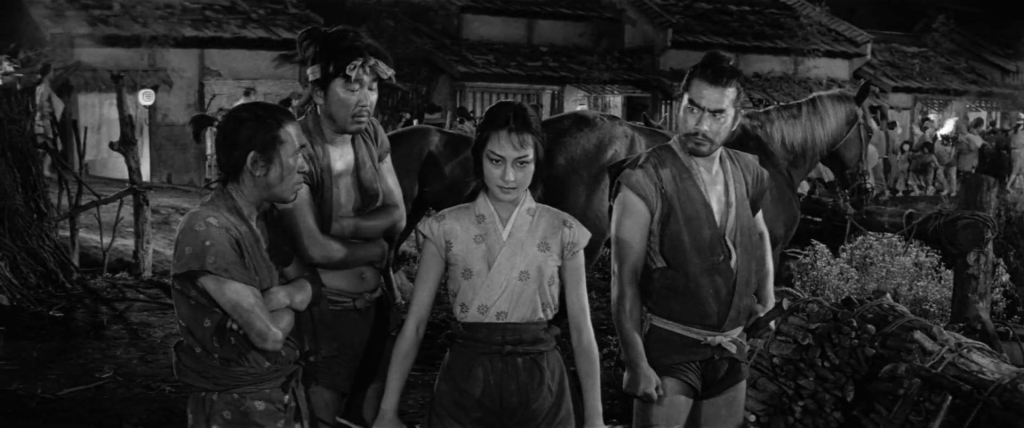
I’ve been trying, recently, to build a concrete library of physical copies of movies, and actually make a collection of significant artists, or at least noted artists with a particular style, like Wes Anderson, or Chris Nolan, or Akira Kurosawa.
Hidden Fortress is frequently cited as an inspiration for Star Wars, though I have to say the resemblance is not very strong–not as strong as certain other influences on Lucas’ work. It’s better to enjoy Fortress on it’s own merits. As a tale of samurai intrigue, it’s compelling and gripping, thanks in large part to the talents of its leads, Toshiro Mifune and Misa Uehara. As a reflection on life and the need to embrace things as they happen, it’s surprisingly poignant.
Where I think it stands out is the inclusion of the whining comic relief characters Tahei and Matashichi, who seem very out-of-place in a samurai epic, but show very clearly Kurosawa’s own deep fascination with American westerns, where such no-good rascals are common. Indeed, I’m inclined to think that Hidden Fortress is quietly subversive for such an early Japanese film with the way it undermines Japanese aristocracy and shows the plight of the average peasant in war.
The Martian
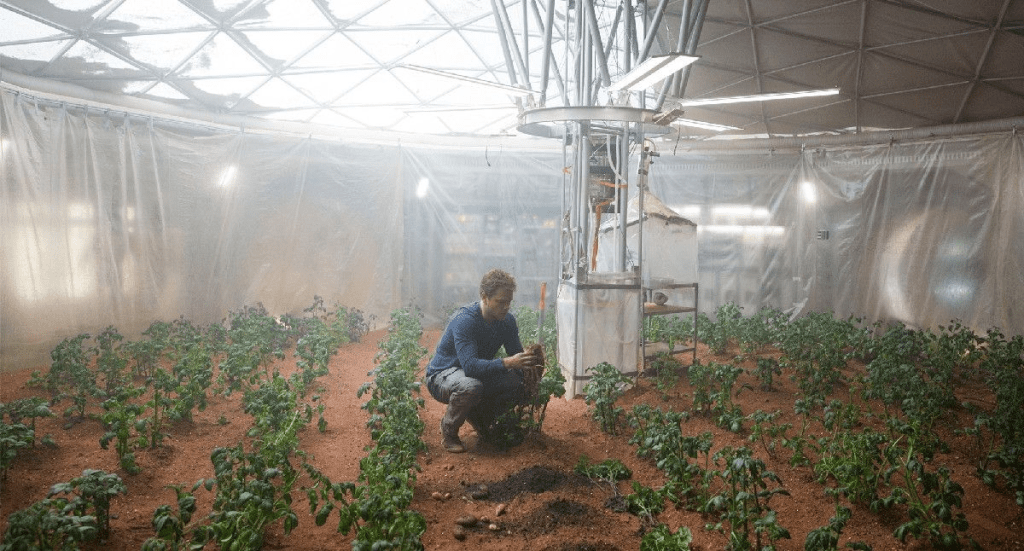
I think I saw this this year. I’ve heard it praised for ages, I’ve seen clips on Youtube for years, I just finally got around to watching the movie itself this year. As for when I’ll read the book… well, that’s probably going to take a bit further yet. But the movie was excellent!
A friend of mine felt that there was an aggressively anti-religious aspect to the movie, referencing a scene where Watney (as played by Matt Damon) burns a wooden cross that he was seen kissing earlier. I think that’s a misreading of the scene, or if that was the director’s intention, they certainly could have been more explicit about it.
Mostly, I liked the movie because it’s a hard sci-fi story that manages, better than any other narrative, to really put space travel firmly into the “pioneer survival” genre that it so clearly belongs in. To me, planetary exploration is the wave of the future, a hugely promising field set to echo the most hopeful days of the Age of Exploration and the Pioneer Spirit. The only problem is that, realistically, NASA would never send out people in a life-or-death mission like so many colonists were sent out on in the early 1600’s. The Martian wonderfully manages to create a setup where a space pioneer gets to act like a Wild West pioneer and struggle to grow crops to survive, and does it in a science-based way. Great fun.
Best Games of 2024
Planet Crafter

My love for The Martian probably explains why I so enjoyed the game Planet Crafter. I find the idea of planetary terraforming endlessly fascinating. To me it’s absolutely mind-blowing stuff. And Planet Crafter, at least at the start, does an excellent job of making the exploration and terraforming of a barren planet a beautiful and engaging experience (toward the last third the game slows down to a mind-numbing degree.)
There’s many reasons why Planet Crafter works well. The tech tree is well put together and allows gradual upgrading of abilities. The environments are varied and beautiful, and the terraforming means that they’re constantly changing, allowing for even more variation (My first playthrough I thought the whole game was procedurally generated, which would have been quite a feat). There’s a constant sense of exploration and discovery that makes the game just enormously fun to play.
The storyline in the game isn’t too compelling, and as I said, in the later stages the game becomes too slow to really appreciate as much. But the rest of it is so wonderfully colorful and gives such a great sense of agency that it really doesn’t matter.
Dave the Diver

This game is the most wonderful counter-example to the stereotypical complaint that “videogames just cater to the male fantasy of sex and violence.” I mean, I would argue that Dave the Diver is indeed a well-pictured male-wish-fulfillment fantasy game, but it’s the fantasy of having a fulfilling job that you are respected and appreciated for carrying out.
In some ways, Dave the Diver has a very simple gameplay mechanic–you’re an overweight diver who during the day hunts fish with their speargun, and then during the night helps out at the local sushi restaurant to feed various demanding patrons. There’s also a plotline about mermaid sea-people and, if you get the DLC, Godzilla, to give a sense of progression and completion to your activities, but outside of that it’s a really satisfying gameplay loop based around making delicious meals for people.
Unicorn Overlord

If Dave the Diver is an atypical example of a male power fantasy, then Unicorn Overlord is an absolutely typical one. You are Alain, the crown prince to the lost kingdom of Corneria, who must form together an army of highly competent, fiercely devoted, good-looking misfits to throw out the evil demonic ruler who might possibly be possessed by the spirits of a long-dead civilization.
Sadly, you are not a unicorn, and indeed no unicorns actually exist in the game, apart from the distant past of ancient legend. Technically the game is a turn-based strategy JRPG, but with the twist that your five-person squads carry out their attacks and spells automatically. All you do is optimize the arrangement of the squads and tweak the prioritization of what abilities they use when (I will confess that I never quite mastered the aspect of tweaking my characters priorities.) This makes battles agreeably fast-paced, but still cinematic, due to some involved animations, and still allows for plentiful strategization of an altogether different sort than turn-based games usually follow.
Outside of that, the art of the game is beautiful, the story is very typically Japanese but still engrossing, and the mechanic of building relationships with your soldiers allows for some compelling moments. It was a game I had legitimate trouble putting down.
Well, so much for my top hits. There were many other good books, good movies, and good games, but these were the ones I felt worthy of a top list. In particular, I’ve been reading a lot more of Lord Peter Whimsey, which I hope to make a full post on in due time. But that will have to wait for now.
 The Solomon Code
Cool to look back at everything you’ve read over the year! I just got Blacktongue Thief out from the library. Are you deliberately trying to read more nonfiction? Or is your taste just naturally trending that way?
LikeLike
No… I read a lot of fiction over the year. Just none of them really stood out like the nonfiction ones did.
Hope you enjoy Blacktongue! It’s definitely a more… mature story, so some of the stuff is a bit squicky, as they say.
LikeLike
gotcha, that makes sense!! The nonfiction ones definitely sound like interesting books. I’ll be on guard for the Black tongue Thief 😊
LikeLike